

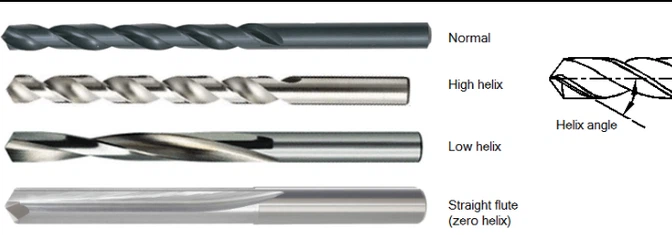
If you closely examine different drill bits, you may notice that the spiral grooves-known as flutes-are not always shaped the same. Some drill bits have a steep spiral, while others appear much flatter.
This difference is called the helix angle, and it plays a crucial role in how a drill bit performs when cutting different materials.
Understanding why drill bits use different helix angles can help explain how drilling tools are optimized for metal, wood, or concrete applications.
What Is a Helix Angle in a Drill Bit?
The helix angle refers to the angle formed by the spiral flute relative to the drill bit's axis.
In simple terms, it determines how aggressively the spiral moves chips (material debris) out of the hole during drilling.
Typical helix angles fall into three general ranges:
| Helix Angle | Typical Use |
|---|---|
| Low helix (10°–20°) | Hard materials and brittle materials |
| Standard helix (25°–30°) | General-purpose drilling |
| High helix (35°–45°) | Soft materials and deep-hole drilling |
Each range changes how the drill bit handles chip evacuation, cutting force, and stability.
Why Helix Angle Matters in Drilling?
During drilling, two things must happen at the same time:
The cutting edges remove material.
The flutes carry chips out of the hole.
If chips cannot escape efficiently, friction increases, heat builds up, and drilling becomes slower or even impossible.
The helix angle helps control how quickly chips move out of the hole.
Low Helix Angles for Hard Materials
Drill bits with lower helix angles are typically used for harder materials such as:
hardened steel
cast iron
certain composite materials
A smaller helix angle creates a stronger drill body and reduces the tendency of the bit to grab the material. This improves stability when drilling tough materials that generate short, brittle chips.
Low helix designs also increase the structural rigidity of the drill, making them more resistant to breakage under high cutting forces.
Standard Helix Angles for General Drilling
Most twist drill bits used for metal drilling have helix angles around 25°–30°.
This range provides a balanced combination of:
efficient chip removal
good drilling stability
moderate cutting forces
Because of this balance, standard helix angles are commonly used for general-purpose HSS drill bits, making them suitable for a wide range of materials such as mild steel, aluminum, and plastics.
High Helix Angles for Soft Materials
Drill bits with high helix angles are designed for softer materials that produce long, continuous chips, including:
aluminum
copper
plastics
some soft steels
A steeper spiral helps move these long chips quickly out of the hole, preventing clogging.
High helix designs also reduce friction between the drill and the hole wall, allowing for smoother drilling and improved surface finish.

Helix Angle Also Affects Cutting Speed and Stability
Beyond chip evacuation, helix angle also influences:
Cutting efficiency
Higher helix angles can increase cutting aggressiveness in softer materials.
Tool strength
Lower helix angles produce stronger drill cores.
Vibration control
Optimized helix geometry can reduce chatter and improve hole accuracy.
For this reason, drill bit manufacturers carefully choose helix angles depending on the intended application.
Helix Angles in Specialized Drill Bits
Different drilling applications require different helix designs.
For example:
Parabolic flute drill bits use deeper flutes and modified helix angles for deep-hole drilling.
Hammer drill bits for concrete often use wider flute designs to quickly remove dust and debris.
High-performance metal drills may use variable helix angles to improve chip control.
These variations demonstrate how drill geometry is tailored to specific drilling challenges.
Final Thoughts
The helix angle may look like a small design detail, but it has a significant impact on drilling performance.
By adjusting the helix angle, drill bit designers can control:
chip evacuation
cutting efficiency
tool strength
drilling stability
This is why drill bits designed for different materials often look similar at first glance but perform very differently in practice.
Understanding these design principles helps professionals select the right drill bit for the job-and explains why specialized tools often outperform general-purpose ones.
Looking for drill bits engineered for specific materials and drilling conditions?
At Ceres Tools, we manufacture a wide range of professional drill bits-from general-purpose HSS drills to specialized designs optimized for metalworking and construction applications.
Contact us to learn more about our drilling solutions and OEM capabilities.