

Compatibility and differences between SDS and non-SDS drill bits
I once wasted hours trying to force a regular drill bit into an SDS hammer drill, damaging both the bit and chuck. This common mistake causes frustration, wasted time, and potentially ruined tools. How can you avoid this costly error?
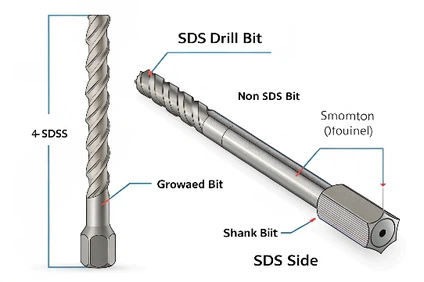
SDS and non-SDS drill bits are not interchangeable due to different shank designs. SDS bits have grooved shanks that lock into hammer drills for rotary-hammer action, while standard bits have smooth or hexagonal shanks for conventional drills.

Let me share what I've learned about these different bit systems and how to choose the right one for your project.
SDS vs Non-SDS Drill Bits Explained
Have you ever wondered why there are different drill bit systems? I remember being confused when I first encountered an SDS bit and couldn't fit it in my regular drill. What exactly makes these systems different?
SDS bits feature specialized grooved shanks that lock into hammer drill chucks, allowing simultaneous rotation and hammering. Non-SDS bits have round or hex shanks that clamp into standard three-jaw chucks and can't withstand hammer action.

The fundamental difference between these bit systems lies in how they transfer power from the drill to the bit. SDS (Special Direct System, originally Steck-Dreh-Sitz in German) was developed by Bosch in the 1970s and revolutionized masonry drilling.
In a standard drill with a three-jaw chuck, the bit is held in place by friction as the jaws clamp around the smooth or hex-shaped shank. This works well for rotary motion but would quickly fail under the intense hammering action needed for concrete or masonry work.
The SDS system, by contrast, uses slots and grooves in the bit shank that mate with corresponding guides in the chuck. This creates a secure connection that can handle both rotary motion and powerful forward hammering action simultaneously.
There are actually several SDS variants that have evolved over time:
| SDS Type | Shank Diameter | Common Uses | Max Hole Size |
|---|---|---|---|
| SDS-Plus | 10mm | Most common for DIY and professional use | Up to 30mm |
| SDS-Max | 18mm | Heavy-duty commercial applications | Up to 50mm |
| SDS-Top | 14mm | Less common European standard | Up to 40mm |
| SDS-Quick | 7mm | Compact, lighter-duty tools | Up to 10mm |
When I'm selecting drill bits, I always check compatibility first. Putting the wrong bit type in a drill can damage both the bit and the tool, as I learned the hard way on a construction project when I tried forcing a regular bit into an SDS drill.
Which is better SDS or non SDS?
I've used both systems extensively, and people often ask me which one is superior. But that's actually the wrong question to ask. Instead, we should be asking: which system is right for your specific job?
Neither SDS nor non-SDS is universally "better" - they serve different purposes. SDS excels at drilling concrete and masonry with hammer action, while non-SDS bits are versatile for wood, metal, and light masonry with standard drills.
The decision between SDS and non-SDS bits should be based on the material you're drilling and the tools you have available. Through my years working with various construction teams, I've learned to match the bit system to the job requirements.
SDS systems offer several advantages for masonry work:
Superior hammering action - The sliding mechanism in the SDS chuck delivers powerful forward impact while protecting the drill's motor from excessive vibration.
Faster concrete drilling - In our production testing, SDS bits typically drilled through concrete 3-4 times faster than non-SDS bits in hammer drills.
Reduced user fatigue - The more efficient hammering action requires less pressure from the operator.
Longer bit life - The specialized carbide tips and heat-treated shafts withstand the extreme forces and temperatures of masonry drilling.
However, non-SDS systems have their own strengths:
Greater versatility - Standard drills accept bits for nearly any material from wood to metal to plastic.
Better precision - The tight three-jaw chuck provides better centering for accurate small holes.
Lower cost - Both the drills and bits are generally more affordable.
Lighter weight - Standard drills without hammering mechanisms are significantly lighter.
I remember working on a renovation project where we needed both systems - SDS drills for anchoring concrete fixtures and standard drills for the wooden framing and metal fixtures. Attempting to use one system for all applications would have been inefficient and potentially damaging to the tools.
Understanding SDS chucks and terminology
SDS terminology confused me when I first started working with these tools. What do all these acronyms mean, and how do they affect compatibility? Let me clarify what I've learned over years in the industry.
SDS stands for "Special Direct System" and refers to a quick-release chuck system for hammer drills. The main variants are SDS-Plus (most common), SDS-Max (heavy-duty), and SDS-Quick (compact), which are not interchangeable.

Understanding SDS terminology is crucial for selecting compatible tools and accessories. The system was originally developed by Bosch, and the German name "Steck-Dreh-Sitz" translates roughly to "insert-twist-stay," describing how the bits lock into place.
The SDS chuck works on a spring-loaded principle. When you insert an SDS bit, you push it against the spring until it clicks into place. The bit can move forward and backward slightly (about 1cm) while remaining locked rotationally - this is key to the hammering action. To remove the bit, you pull back the chuck collar, which releases the locking mechanism.
Here's a more detailed look at the different SDS standards:
| Feature | SDS-Plus | SDS-Max | SDS-Quick |
|---|---|---|---|
| Shank Diameter | 10mm | 18mm | 7mm |
| Groove Pattern | 2 open grooves + 2 closed grooves | 2 open grooves + 3 closed grooves | 2 open grooves + 2 closed grooves |
| Tool Weight Class | 2-4 kg | 5-10 kg | 1-2 kg |
| Typical Applications | General construction, medium-duty | Heavy demolition, large holes | Light-duty, DIY applications |
| Maximum Recommended Hole Size | 30mm | 50mm | 10mm |
A common misconception I encounter is that "SDS" stands for "Slotted Drive System" or "Special Drilling System" - both are incorrect. Similarly, many people don't realize that SDS-Plus and SDS-Max bits cannot be used interchangeably, despite sharing the same basic concept.
Some modern drills feature multi-chuck systems that can accept both SDS and conventional bits. I've found these useful for smaller jobs, but for serious masonry work, a dedicated SDS hammer drill delivers superior performance. The first time I used a proper SDS-Plus drill on concrete after struggling with a regular drill, the difference was remarkable - what had taken minutes took seconds instead.
Conclusion
Choose SDS bits for concrete and masonry work with hammer drills, and non-SDS bits for general drilling in wood, metal, and plastic. They're not interchangeable, so match the bit type to your drill and material for best results.